Make vs Zapier: which one fits your workflows
Both tools connect the apps your team already uses, and both start free. Make vs Zapier is decided by the shape of your workflows: a straight line or a map with branches.
On this page
Make vs Zapier at a glance
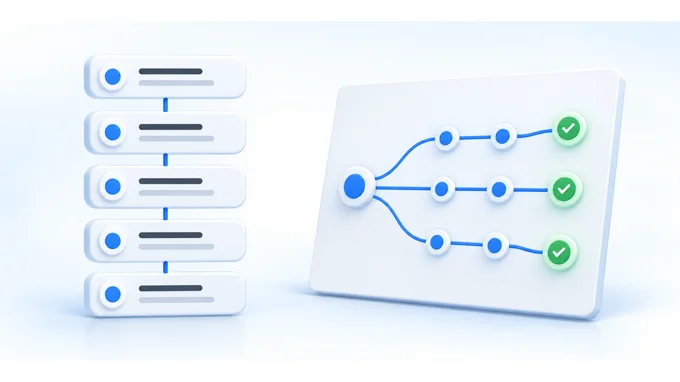
Zapier or Make: a step list or a canvas. Zapier builds a workflow as a list that reads top to bottom. Make draws it as a map, with every branch in view.
| What you compare | Make | Zapier |
|---|---|---|
| How you build | A visual canvas, branches drawn as routes | A step list, with paths for branches |
| How it charges | Credits, one for most steps that run | Tasks, one per action that succeeds |
| Free start | A free plan with a small monthly credit allowance | A free plan with a small monthly task allowance |
| App library | A large app library, plus any tool with an API | The biggest library of the three common tools |
| Where it runs | Make's cloud | Zapier's cloud |
| AI agents | Built in | Built in |

Where Zapier wins: straight handoffs
The fastest path from idea to a working workflow. You set a trigger and add steps in a list. The next person on your team can read it top to bottom and fix it.
Checks cost nothing. Triggers, filters and paths do not count as tasks. A workflow that skips most entries pays only for the ones it acts on.
Built for the whole team. Tables and forms sit next to the workflows on every plan, so a small team collects, stores and moves data in one place.
Where Make wins: branching work
You see the whole flow at once. Make draws every route on one canvas, so a workflow with several branches stays readable.
Data clean up is built in. Routers, filters and data mapping sort, split and reshape records before they reach the next app.
Any tool with an API fits. An API is the connection a tool opens to other software. When an app is missing from the library, an HTTP module, a step that calls that connection, links it.
Pick by the shape of the work
-
One trigger, a few steps
Zapier. It is live quickly and easy for the next person to read.
-
Several branches and data clean up
Make. The canvas keeps every route in view.
-
A mix of both
Keep simple handoffs in Zapier and complex flows in Make. Each bill matches its job.
Your workflows do not fit either column? Book a call and get a pick for your busiest workflow.
Zapier vs Make on cost: tasks against credits
Zapier counts what succeeds. Each action that completes is one task. Triggers, filters and steps that never run are free.
Make counts what runs. Most steps use one credit each time they run. AI steps can use more. Credits beyond your plan cost extra.
One branching workflow, counted both ways. A form entry arrives. A filter passes real inquiries and stops spam. Each real inquiry takes 3 actions: add it to the CRM, alert sales and send a reply. The form gets 1,000 entries a month and 600 are real.
| What you compare | Make | Zapier |
|---|---|---|
| What counts | 3 actions on the 600 real ones, plus one credit each time the trigger checks for entries | Only the 3 actions on the 600 real ones. Triggers and filters are free |
| Monthly count | 1,800 credits plus the trigger checks | 1,800 tasks |
| Plan it fits, 2026 | Core, 10,000 credits a month at $9 a month billed monthly | Professional, 2,000 tasks a month at $49 billed yearly, $73.50 billed monthly |
Prices from Make pricing and Zapier pricing (vendor pricing page, 2026). Make counts credits, Zapier counts tasks, and one Make plan holds far more units. Price both at your own volume before you pick.
Compare at your real volume. Count the runs per month and the steps per run, then price both. Plan prices change often, the counting rule decides the bill. Each tool has a free plan with a small monthly allowance, enough to test one real workflow before you pay.

Signs you picked the wrong one
Zapier: your list keeps growing sideways. Paths handle branches. A flow with many of them turns into a long list. Every action in it counts as a task.
Make: only one person can read the canvas. The canvas takes time to learn. If the builder leaves, someone has to learn it before they can fix it.
Either: data that must stay on your servers. Both run in their own cloud. If your rules call for your own server, read n8n vs Make.
How to choose between Make and Zapier
Draw the workflow first. A straight line points to Zapier. A map with branches points to Make.
Then run it for a month on a free plan. Both tools start free, so test the real workflow before you pay for either.
Rather have it built? Our business automation services build it in Make, Zapier or n8n, test it on your real work and walk your team through it. To find the jobs worth automating first, start with the free automation assessment. It prices every recurring job per month.
Before you build
Get a tool pick sized to your monthly volume.
30 minutes, free. Bring one workflow and leave knowing the cheaper way to run it, and who can build it.
- What you get
- A free automation assessment with your repeated jobs priced and the first system named.
- How it is priced
- The assessment is free. We quote after the first call.
- What you bring
- A list of the jobs your team repeats every week.
Prefer to write? Send us a message.
Questions founders ask about Make and Zapier
Is Make better than Zapier?
For workflows with branches and data clean up, Make is often the better fit. For simple handoffs your whole team can maintain, Zapier is.
Is Make cheaper than Zapier?
Not always. Make counts most steps that run, Zapier counts only actions that succeed and skips filters.
Are Make and Zapier the same thing?
They do the same job: they connect apps so work moves on its own. They are separate companies with different builders and different ways of counting usage.
Which one is easier for beginners?
Zapier: its step list reads top to bottom, and its assistant can draft a workflow from a plain description. Make's canvas takes longer to learn and gives more control after that.
Can Make and Zapier work together?
Yes, both accept webhooks, a signal one tool sends to start the other. A workflow in Zapier can start one in Make, and the other way round.